How Art Helps Heal PTSD: 5 Insights From Personal Experience
Art can help heal post-traumatic stress in ways that words alone struggle to reach. Painting, sculpting and creative work let you process trauma without first turning it into a story that has to be told in sentences. I know this from personal experience: I am Eliran Bar-On, an Israeli oil painter, and I have lived with PTSD for years, the result of classified operations during my military service. This article brings together what the research says, what I have learned at the canvas, and how you can begin, whether or not you have ever held a brush.
What Happens to a Person Who Experiences Trauma
Post-traumatic stress disorder (PTSD) is a natural response of the brain to an extreme experience. Memories are stored with unusual intensity, the body stays in a state of alertness, and the mind keeps looking for a way to process what happened. Words often fall short: emotions become tangled, memories fragment, and the body reacts before the mind can explain. According to the World Health Organization, PTSD affects roughly 3.9 percent of the world's population, and among survivors of war, violence and accidents the share is far higher. This is exactly where art steps in: painting, drawing, collage or sculpting all allow expression beyond language.
Why Art Reaches Where Talking Does Not
Trauma is stored in the body and in images, not in sentences. When the linguistic parts of the brain shut down under stress, the visual and physical channels remain open. That is why a person who cannot describe what happened can often paint it, and why a rough, "ugly" painting made in ten minutes can release something a year of careful conversation did not. You do not need to be good at art. On the contrary: the freedom to create without judgment is what allows body and soul to speak together.
How Painting Helps Process Trauma: 5 Insights From Experience
Creative work helps through several mechanisms that I have felt at the canvas and that research confirms. Art is a real tool for healing, not only emotional expression but a process that changes how the brain handles traumatic memory.
- Restoring control. The painter chooses what to paint, how, and when to stop. That structure creates a sense of control at a time when reality was chaos. For me, deciding the size of a canvas was the first decision in years that was entirely mine.
- Expression without words. Trauma shuts down the language system. Painting lets you say what cannot be said, and lets other people receive it without you having to explain.
- Processing the memory from a distance. Working on a canvas puts a symbolic distance between you and the experience. You look at it, you change it, you leave it on the easel and go make coffee. It stops swallowing you.
- Presence through the body. The movement and physicality of painting, the arm, the pressure of the brush, the smell of linseed oil, release energy that got stuck in the body and bring you back into the present moment.
- A marker of survival. A finished painting is evidence. It is not only an object on the wall; it is a witness that says: this happened, and I am still here, and I made something from it.
My Personal Story
I did not arrive at painting as an art student; I came to it out of need. When I paint, the chaotic noise of trauma subsides and is replaced by a quiet with a clear purpose. Each stroke feels like releasing one fragment of what once consumed me. The textures, the colors and the slow, immersive nature of oil painting gave me a tangible way to manage anxiety, to sit with flashbacks without being taken by them, and to reconnect with myself. Over time I understood that creating is not only expression or a pleasant hobby: it is deep inner work that changes the relationship you have with yourself and with the pain you carry. Every painting I have finished since then is a small personal victory, and sharing them has shown me that they help other people feel less alone in the same struggle. Turning darkness into something that can hang on a wall is not a metaphor for me; it is how I live.
What the Research Says About Art and Trauma
Studies in neuropsychology have found that creative activity engages the brain's regulating systems and improves emotional processing. Work published in journals such as Frontiers in Psychology supports the use of art-based therapy for post-traumatic stress: creating helps reduce dissociation and reconnect body and mind, process traumatic memories in a nonverbal way, rebuild a sense of control and safety, and improve integration and wellbeing. In recent years, art therapy has become a recognized tool in treating PTSD, especially among survivors of war, violence and accidents.
Art Therapy or a Private Studio?
Painting on your own is not clinical treatment, and it does not replace it. The two work together: painting opens doors that guided therapy can then walk through, and therapy gives the safety to keep painting when the images get hard. If you have a therapist, tell them you have started painting; if you do not, a certified art therapist is a good first door, and so is a quiet corner with a canvas and no one watching. What matters is not to wait for permission.
How I Work With Trauma in Painting
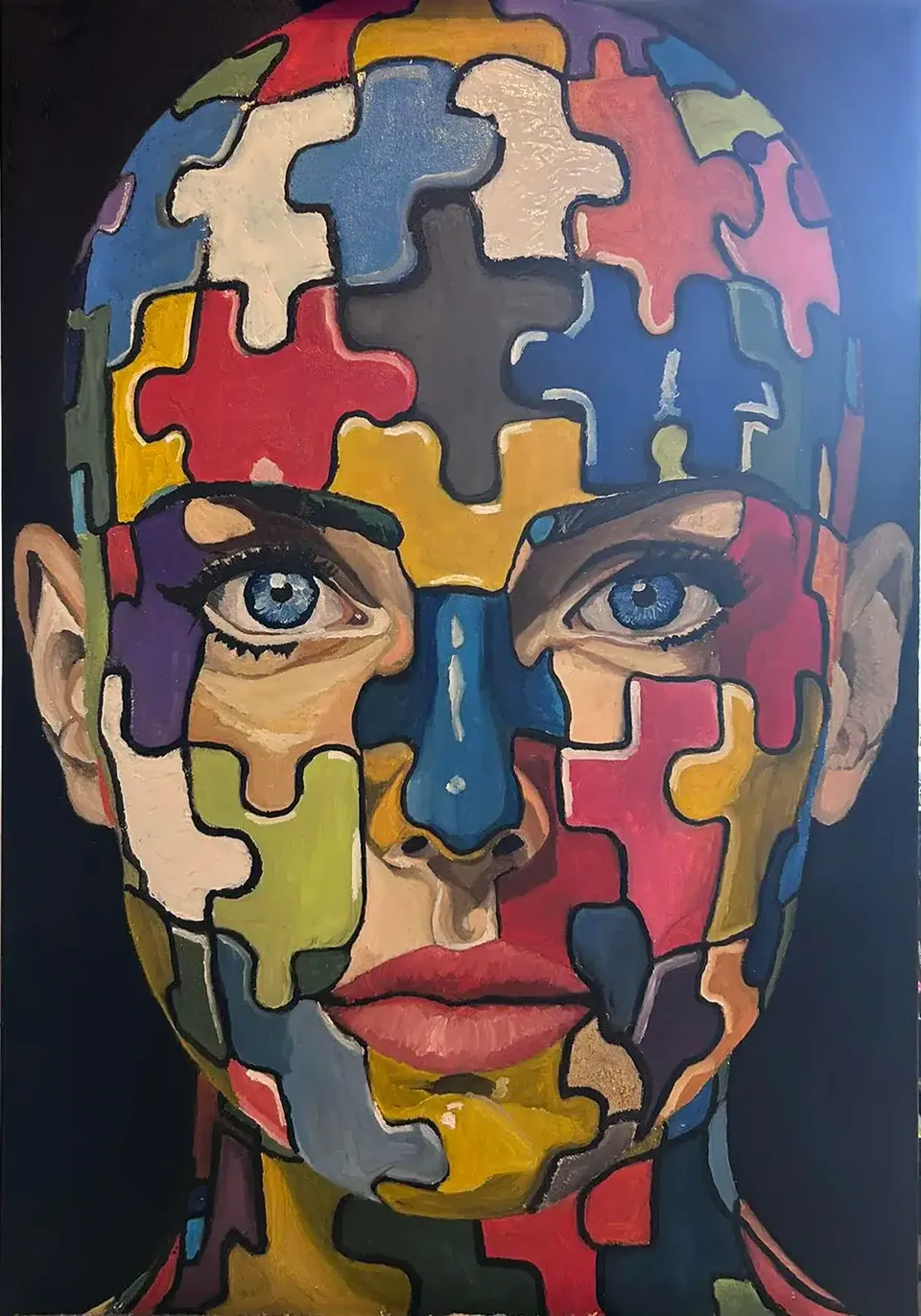
My works are not stories about trauma; they are born from the process of working through it. When I approach the canvas I usually do not know what will come out. I start with a fog, with a sting, with a color that felt cracked in the morning. At the point where the work begins to speak, I listen. This taught me that healing does not happen in one moment. It accumulates slowly, meeting after meeting with the canvas, until something inside dissolves and lets go. Trauma does not disappear when you paint it; it changes when you tell it in a new way, in color and form instead of words. You can see this in the works of the rupture, healing and identity and resilience and freedom collections, and in the series I painted after October 7th.
How to Start, Today
You do not need to be an artist and you do not need to know how to draw. You need something that wants to be said, and a tool to say it. A few practical suggestions from someone who started exactly there:
- Keep it small and cheap. A sheet of paper and a pen, a child's set of acrylics, a 20 × 30 cm canvas board. Expensive materials create pressure to make something "good".
- Set a timer for ten minutes. Paint what the morning felt like, not what it looked like. Stop when the timer rings, even mid-stroke.
- Do not judge the result. Turn it to the wall if you must. The healing is in the making, not in the picture.
- Come back tomorrow. Consistency matters more than talent. Three short sessions a week change more than one long one a month.
- Tell one person. A therapist, a friend, a group. Trauma isolates; making and sharing reconnects.
If my works speak to you and something in this text resonates, you may be in a process of your own. I understand this path. You are welcome to explore my gallery, read my personal account of PTSD and painting, or reach out; I answer every message myself.
Related collections